


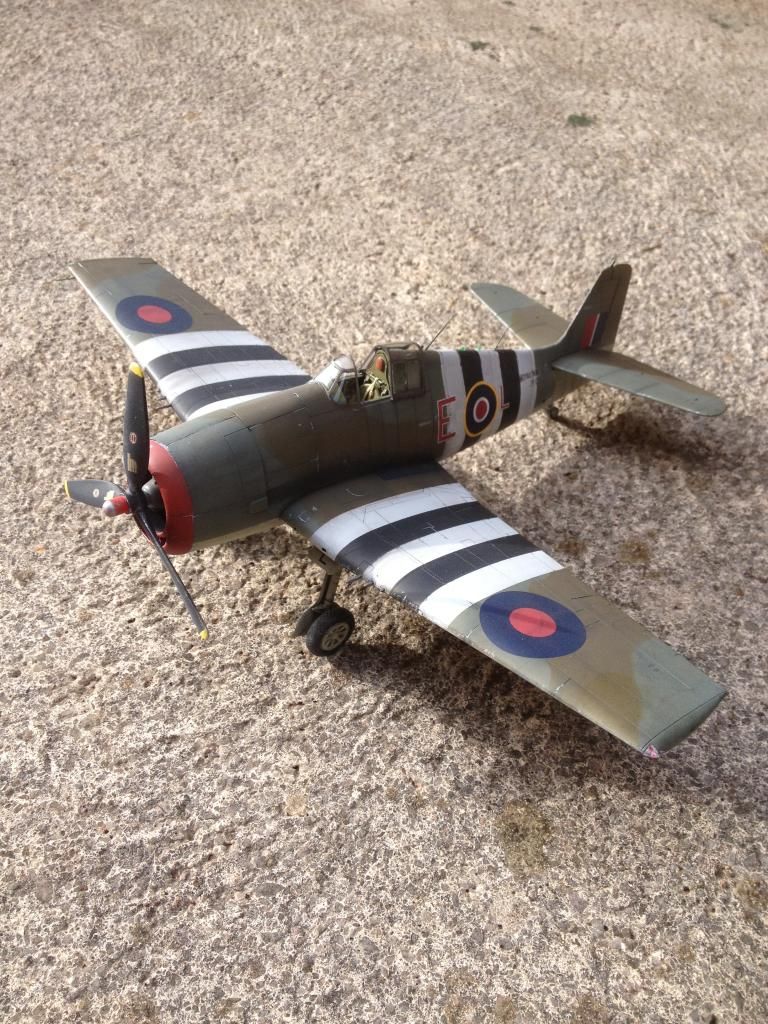
A History of 800 Naval Air Squadron
No.800 Squadron formed on 3 April 1933 as a Fleet Fighter squadron by the combining of Nos.402 and 404 Flights; their initial equipment was 9 Nimrods and 3 Ospreys. The squadron embarked in HMS Courageous. In October 1938 the squadron began to re-equip with Blackburn Skuas, and the the squadron embarked in HMS Ark Royal in the New Year.
Whilst ashore at RNAS Hatston, Skuas of Nos.800 and 803 Squadrons dive bombed the German cruiser Konigsberg at Bergen, during the German invasion of Norway. Later, squadron pilots shot down 6 He 111's, but in an abortive attack on the German battle cruiser Scharnhorst four aircraft were lost and the C.O. was taken prisoner. In July 1940 the squadron provided fighter patrols and escorts during an attack on the French Fleet at Oran.
800 squadron left HMS Ark Royal at Gibraltar in April 1941, transferring to HMS Furious the squadron was reequipped with nine Fulmars at RNAS Lee-on-Solent at the end of April. It was further expanded to 18 aircraft by absorbing the nine Fulmars of 801 squadron which disbanded at RNAS Lee-on-Solent on May 2nd. From May 2nd the squadron was temporarily split into three flights: No.800X Flight (9 aircraft) embarking in HMS Furious for a six months spell in Malta, No.800Y Flight (3 aircraft) embarked in HMS Argus, the remaining 6 aircraft became No.800Z Flight embarking in HMS Victorious to help search for the Bismarck.
Y & Z flights disbanded when 800 squadron regrouped at RNAS Lee-on-Solent on June 14th 1941, X flight remained ashore at RNAS Hal Far, Malta until it disbanded on November 19th. During July 1941 800 squadron joined HMS Furious for an attack on the Finnish port of Petsamo, in which it lost two aircraft to German fighters.
800 next transferred to HMS Indomitable in October 1941, the ship operated in the West Indies until the end of the year and then sailed for the Indian Ocean to participate in the Madagascar operations. The squadron reequipped again in June 1942 when Sea Hurricanes were received, and with these the squadron returned to the United Kingdom at the end of August. In October the squadron embarked in HMS Biter to take part in the North African landings during November. On March 24th 1943, 800 squadron embarked on HMS Unicorn for deck landing training in the Clyde and short period of anti-submarine operations in home waters.
In June 1943 the squadron arrived at RNAS Eglinton, Northern Ireland where they were to become the first Fleet Air Arm unit to receive the new Grumman Hellcat, reequipping with 10 aircraft in July. In October 1943 800 squadron was joined by No. 804 (Hellcat) squadron to form No.7 Naval Fighter Wing, embarking in HMS Ravager October 28th - November 4th deck landing training


On 5 December 1943 800 squadron embarked in HMS Emperor which was tasked with providing air cover for a USA-bound convoy with a return trip with the ship acting as a transport. HMS Emperor next joined the Home Fleet and her squadrons took part in several operations against targets in Norwegian waters including providing escorts for attacks on the German battleship Tirpitz. Following action in the Western Approaches during May and June 1944 when Emperor covered D-Day operations, On June 18th No.804 Squadron was absorbed by 800 squadron to form a single 20 aircraft squadron.

HMS Emperor sailed for the Mediterranean on July 15th with 800 squadron embarked to take part in Operation "Dragoon", the invasion of the south of France in August. From early September Emperor, in company with Pursuer began strike operations in the Aegean, these operations saw 800 squadron attacking shore targets and shipping beginning with Operations "Outing I & II" and Operation "Manna", in October. Later in October the squadron provided strikes to soften up the Island of Milos prior to its re-occupation in Operation "Contempt"; In the whole series of operations in the Aegean, Emperor's aircraft flew 455 sorties, the majority being flown by 800 squadron, more than double that achieved by any other carrier.
On returning to the United Kingdom, the squadron disembarked to RAF Long Kesh, Northern Ireland on November 29th 1944 to re-equip with new Hellcats and train for operations in the Far East. Emperor had completed a short refit at a dockyard in Newport South Wales and was ready to re-embark 800 squadron by February 25th 1945 before she sailed for Ceylon via the Suez Canal on March 1st.
Upon arrival in Ceylon 800 was disembarked to Royal Naval Air Station Colombo Racecourse on March 25th, while Emperor began storing ship for operations as part of the East Indies Fleet. Emperor and 800 squadron were soon in action, participating in Operation "Sunfish" at the beginning of April. This was a photographic reconnaissance over flight of Port Swettenham and a strike on Emmahaven, carried out in company with HMS Khedive. On April 31st 800 and Emperor took part in Operation "Dracula", a series of strikes on the Rangoon and Tenasserim (south-eastern Burma), coast in company with CVEs Khedive, Hunter and Stalker. During the later part of "Dracula" operations 800 squadron operated detachments from two of the accompanying CVEs, three aircraft operated from HMS Khedive and eight from HMS Shah between 11th - 19th May before rejoining Emperor.
After a brief break, when 800 again disembarked to Colombo Racecourse, Emperor put to sea again on June 18th, a detachment of eight aircraft again joined HMS Shah from where they operated between June 24th and July 1st. This detachment returned to Emperor in time for her next action, Operation "Collie" which commenced on July 2nd. "Collie" called for Emperor, in company with HMS Ameer, to carry out strikes on the Nicobar Islands and to provide air cover for minesweeping forces operating off Phuket Island. On completion of Operation "Collie" Emperor returned to Ceylon on July 19th and 800 was disembarked to Royal Naval Air Station Katukurunda.
800 and Emperor were next called into action at the start of September when together with sister CVEs Ameer, Empress, Hunter, Khedive, and Stalker they were tasked with the reoccupation of Singapore, code name Operation "Zipper". The force anchored in Keppel Harbour, Singapore on the 10th, the surrender was signed on the 12th.


On leaving Singapore Emperor proceeded to Royal Naval Aircraft Maintenance Yard Coimbatore in Southern India were 800 squadron was disembarked on September 18th. The squadrons Hellcats were to remain at Coimbatore and the aircrews rejoined the ship in preparation for return to the UK.
At the beginning of November Emperor sailed for the UK via Colombo and Bombay, 800 squadron officially disbanded upon arrival on the Clyde on 5 December 1945.


Hellcats of the British naval forces entered combat operations at the end of 1943 from escort carriers off the shores of Scandinavia. They were tasked with convoy escort duties, along with escorting bomber and torpedo aircraft, and themselves were also tasked with ground attack missions. During the course of these missions, combat with enemy aircraft was rare. Practically the only recorded combat with German fighters came about on May 8th, 1944, when aircraft from the decks of HMS Emperor engaged Bf 109 Gs and Fw 190 As from JG 5, and claimed three for the loss of one. Other operational areas included the English Channel, where convoy duties were fulfilled, and cover for the Normandy landings. In the MTO, FAA Hellcats , along with American fighters, provided air cover for invasions of southern France.
From the end of 1944, and the beginning of 1945 in particular, Hellcat activity shifted to the Pacific. Along with the British Pacific fleet, combat operations were centred in the vicinity of Malaysia, eastern India, Sumatra, supported American landings on Okinawa and flew recon and ground attack missions in and around the Japanese islands. Hellcat pilots engaged ground, sea and air assets of the enemy, most often protecting allied shipping from kamikaze attacks and denying enemy reconnaissance attempts. In the air, British Hellcats destroyed 52 Japanese aircraft. The most successful Hellcat pilots were from 1844 and 1839 Squadrons FAA, flying from the HMS Indomitable. Combatants from 1844 Sqn accounted for 28 kills, and those from 1839 Sqn twelve.
The career of the Hellcat in British service essentially ended in 1945, when the majority of 12 user squadrons were disbanded or re-equipped with British designs. The NF.Mk.II and PR.Mk.II lasted in service until 1946. Outside of frontline service, a number of Hellcats were in service up to the early fifties.


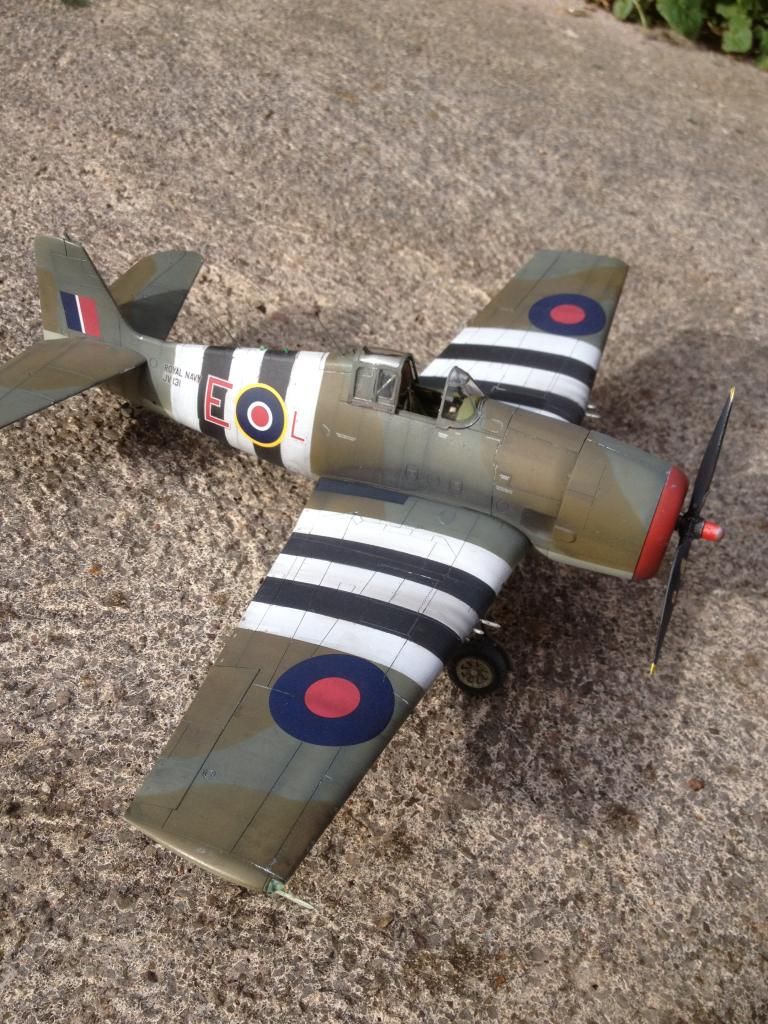
A lovely kit this, Eduard certainly give the modeller loads of choice with their Duo-Combo ProfiPACK.... Two complete kits (Mk.I and Mk.II) loads of Photo-etch, resin bits and mask's
 . There is a school of thought that Eduard stuff can be a bit fiddly and yes on this example the undercarriage had to be fitted before the painting due to its fiddlyness. Eduard kits certainly are recommended to all standard of modellers, beginners to advanced......
 Thanks for looking guys...
TTFN






 great job mate, really nice looking plane.


