Thanks! Not sure how good this will be it will require a few things I haven't done before so we'll see how it turns out.
So a bit of the story behind the Corvette in general and the Grand Sport in particular.
Corvette
The corvette is the first american sports car with the first model released in 1953. The original concept and later model where designed by Harley Earl who took inspiration from the sports cars that raced in post war Europe. For the first two years it had a straight 6-cylinder engine with 150 hp. This and the leaf sprung solid rear axle didn't give the car the sporting performance it should have. So for 1955 the engine was replaced with a V8 to gain some much needed power, at this time it became a true sports car. The first gen corvette revived some styling updates and increased engine displacement until the final year 1962.

1953 Corvette
The second generation (C2) Corvette, which introduced Sting Ray to the model, continued with fiberglass body panels, and overall, was smaller than the first generation. The C2 was later referred to as mid-years. The car was designed by Larry Shinoda with major inspiration from a previous concept design called the "Q Corvette," which was created by Peter Brock and Chuck Pohlmann under the styling direction of Bill Mitchell. Earlier, Mitchell had sponsored a car known as the "Mitchell Sting Ray" in 1959 because Chevrolet no longer participated in factory racing. This vehicle had the largest impact on the styling of this generation, although it had no top and did not give away what the final version of the C2 would look like. The third inspiration was a Mako Shark Mitchell had caught while deep-sea fishing. This is the model that the Grand Sport was based on.

1963 Corvette Sting Ray
For a bit more history on the corvette
http://en.wikipedia.org/wiki/Chevrolet_Corvette
Zora Arkus-Duntov
Zora is considered as the "father of the Corvette" but before joining Chevrolet in 1953 he was more known for the company Ardun that he and his brother had. They where making overhead valve heads for Ford flat head V8 engines that where popular among hot rodders and racers. Coming from this background and being a armature racer himself, he among other things held the record at Pikes Peak, he thought that Corvette needed to be raced to prove it was a "proper" sports car. But as GM had signed a agreement not to have a factory racing program this proved to be a problem. So Zora set up a sort of skunk works with a few trusted engineers and mechanics to build racing cars that where then lent to private teams, like Mitchel's Sting Ray and Cunningham's LeMans racers. One of the bigger project where the Grand Sport.

Zora in his prototype Corvette race car

1959 Mitchel's Sting Ray

Cunningham's LeMans Corvette at LeMans in 2013
Grand Sport
The GS was Zoras answer to Shelby's Cobras and the plan was to build 125 cars to get it homologated by the FIA. To start off five prototypes where build, big focus where put on saving weight compared to the street car. To achive this the body was made from one layer fiber glass and a lot of the steel where replaced by aluminium and magnesium. For a full list of difference between the street car and the GS go here
http://www.racingicons.com/gs/gsdiff.htm.
Zora took Grand Sport #001 to Sebring in December of 1962 for testing. Since the 377 cubic inch engines being developed for the Grand Sports were not yet ready the car used a modified production L84, fuel-injected 327 engine. The disc brakes proved to be a problem (larger, vented rotors would ultimately be fitted) but, having run within seconds of the track record, the testing program was deemed a success.
News of the Sebring test reached GM’s Chairman Frederic Donner and in January of 1963 word came down that all racing efforts were to be stopped. The FIA application was hastily withdrawn when GM canceled all racing programs, having decided to follow the 1957 AMA anti-racing resolution to the letter.
While all factory racing efforts were officially dead, Grand Sport #003 was loaned to Díck Doane and G. S. #004 to Grady Davis for racing in SCCA events. Lacking factory support, their results were mixed, but, after many modifications, Davis, with Dr. Díck Thompson at the wheel, was able to take #004 to an overall victory at the August, 1963 SCCA Nationals at Watkins Glen. Since both cars resembled production Corvettes and were fitted with production engines, little notice was taken. Both cars were returned to Chevrolet in October, 1963.

004 in its first version
After their return, Grand Sports #003 & #004 and un-raced sibling #005 were reworked to reflect lessons learned on the track. Slots and vents were opened up in the bodywork for increased cooling of the brakes and differential. New, wider 9½ inch wheels and tires were fitted resulting in the addition of the Grand Sport "trademark" fender flares.
Most significantly, the engine that Zora had originally planned for the Grand Sports was finally ready...
This 377 cubic inch small block was fed by four 58mm Weber carburetors through a special aluminum cross-ram manifold. The engine was said to produce 485 horsepower at 6000 rpm.
In December, 1963, three of the Grand Sport Coupes (#'s 003, 004 & 005) were shipped to Nassau for the annual Speed Week. Texan John Mecom fronted the "private" team entry. Co-incidentally, several Chevrolet engineers were noted as taking vacations in the Bahamas that year.
The two Grand Sports entered in the Tourist Trophy race on Sunday at Nassau qualified well, second & third on the grid, but both dropped out during the race with over-heated differentials. Differential coolers were provided by one of the "vacationing" engineers who just happened to be carrying some in his luggage and were fitted to the three coupes in time for the Governor's Cup race on Friday.
With the modifications, race results blossomed. In Friday's race the Grand Sports finished third, fourth & sixth, well ahead of the Cobras. The two Grand Sports entered in the final race of the week, Sunday's Nassau Trophy, finished fourth and eighth, again leaving the Shelbys far behind.

005 at Nassau
Back in their Warren shop, the engineers began work to solve the remaining problems uncovered in the Nassau Speed Week events. Air pressure build-up in the engine compartment of the Grand Sports had required the hoods be taped to prevent their departure. This pressure combined with the large frontal area and high profile of the coupe body to aggravate the alarming tendency of the Grand Sport to lift the front end at speed.
In preparation for the Daytona endurance race in February of 1964, Zora’s engineers converted Grand Sport coupe #’s 001 & 002 to roadsters by amputating their roofs to reduce their profile and frontal area. Special louvered hoods were also fitted to relieve the engine compartment pressure problem.
Unfortunately, these modifications proved to be the last applied to the Grand Sports by Chevrolet Engineering. The Nassau successes and their attendant publicity again brought the Grand Sport project to the attention of General Motors’ corporate brass. And again, the bosses disclaimed any corporate involvement in racing and ordered the cars destroyed. Insiders at Chevrolet immediately whisked the three coupes off to private hands, where they met with modest racing success in subsequent years. The two roadsters remained hidden inside the Chevy labyrinth in Warren, Michigan. They surfaced only for rare car show appearances before being sold to Penske in early 1966.
Jim Hall, Roger Penske and #005
When the GSs where given away to protect them from being destroyed chassis number 005 where given to Roger Penske. Penske has become a American racing legend, mostly as a team owner. With running teams in NASCAR, F1, CanAm, sport cars and Indycar with record such as the most Indy 500 titles of any team, 15. But in the late fifties and early sixties he was more known as a driver. His plan for the car was to compete in the 12 of Sebring in March 1964.

Roger Penske
But as the car wasn't ready to race he decided to send it to Jim Hall and Chaparral cars. Hall is another of the big American racing legends as an engineer. He was one of the first to really take advantage of aerodynamic down force, both from wings and from ground effects as well as composite chassis and hydraulic semi automatic shifting. And all of these at least a few years ahead of any body else, and in some cases more then ten years.
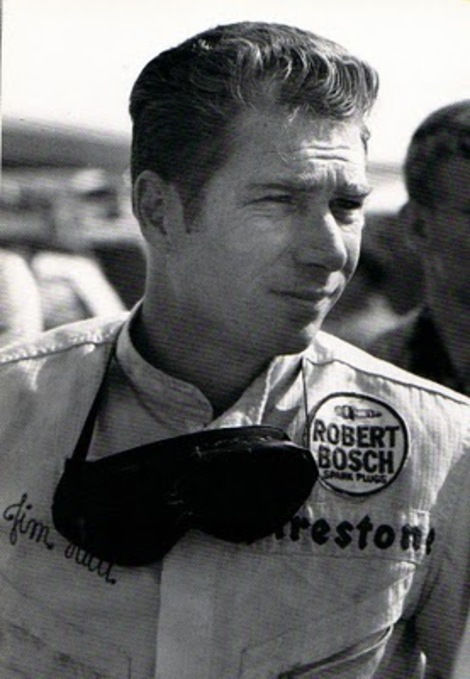
Jim Hall
Hall set to work modifying the GS first by adding air jacks to make tire changes quicker, high pressure oil filler to be able to quilcky refill oil in case of a leak. He also added an extra oil cooler for the differential and a bigger pump for the diff oil and made some small aerodynamic upgrades to try to get the front end a bit more stable. He then finished the car in the signature Chaparral white. Penske and Hall finished 18th in the race and 4th in class 37 laps behind the winning Ferrari 275 P driven by Parkes and Maglioli. A lot of that time where lost when Penske broke a half shaft and the team had to find a Corvette in the parking lot and borrow a half shaft from. Penske had to walk back to the pit to get the shaft and then back to the car and replace it by himself.

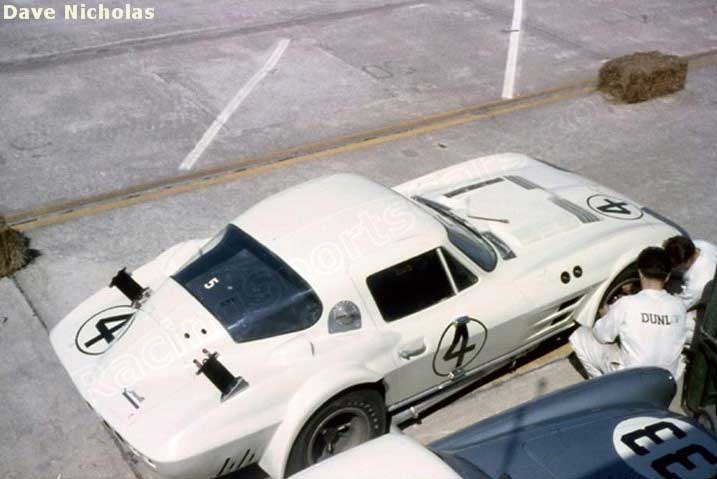
Chassis 005 at Sebring in 1964

The five GSs as they look today
Specification
Frame: Tubular steel frame
Body: Extra thin fiber glass
Engine: 377 cui cast iron block aluminium head V8
Induction: Four 58 mm dual port Weber carburetors
Power: 550 hp at 6400 rpm
Weight: 1162 kg
Wheelbase: 2489 mm
Length: 4554 mm
Width: 1768 mm
[youtube]BeDdXceXH0M[/youtube]
Recap of Sebring 1964


 Keep it up mate


 Being an auto modeller for years I have to say this is one of the best built GS's I have ever seen!


 I like the Accurate Miniatures kits.I built the McLaren M8B years ago when it first came out,but never had a chance to build the Corvette.