Just a bit of history on the Corsair for you to have a look at guys.
The Chance Vought F4U Corsair was an American fighter aircraft that saw service primarily in World War II and the Korean War. Demand for the aircraft soon overwhelmed Vought's manufacturing capability, resulting in production by Goodyear and Brewster: Goodyear-built Corsairs were designated FG and Brewster-built aircraft F3A. From the first prototype delivery to the U.S. Navy in 1940, to final delivery in 1953 to the French, 12,571 F4U Corsairs were manufactured by Vought, in 16 separate models, in the longest production run of any piston-engined fighter in U.S. history (1942–53).
The Corsair was designed as a carrier-based aircraft. However its difficult carrier landing performance rendered the Corsair unsuitable for Navy use until the carrier landing issues were overcome when used by the British Fleet Air Arm. The Corsair thus came to and retained prominence in its area of greatest deployment: land based use by the U.S. Marines. The role of the dominant U.S. carrier based fighter in the second part of the war was thus filled by the Grumman F6F Hellcat, powered by the same Double Wasp engine first flown on the Corsair's first prototype in 1940. The Corsair served to a lesser degree in the U.S. Navy. As well as the U.S. and British use the Corsair was also used by the Royal New Zealand Air Force, the French Navy Aéronavale and other, smaller, air forces until the 1960s. Some Japanese pilots regarded it as the most formidable American fighter of World War II, and the U.S. Navy counted an 11:1 kill ratio with the F4U Corsair.
After the carrier landing issues had been tackled it quickly became the most capable carrier-based fighter-bomber of World War II. The Corsair served almost exclusively as a fighter-bomber throughout the Korean War and during the French colonial wars in Indochina and Algeria.
Engine considerations
The F4U incorporated the largest engine available at the time: the 2,000 hp (1,500 kW) 18-cylinder Pratt & Whitney R-2800 Double Wasp radial. To extract as much power as possible a relatively large Hamilton Standard Hydromatic three-blade propeller of 13 feet 4 inches (4.06 m) was used.
Technical Issues
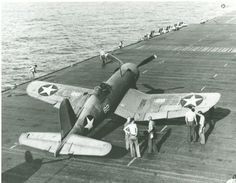
In part because of its advances in technology and a top speed greater than existing Navy aircraft, numerous technical problems had to be solved before the Corsair would enter service. Carrier suitability was a major development issue, prompting changes to the main landing gear, tail wheel and tailhook. Early F4U-1s had difficulty recovering from developed spins, since the inverted gull wing's shape interfered with elevator authority. It was also found that the Corsair's starboard wing could stall and drop rapidly and without warning during slow carrier landings. In addition, if the throttle were suddenly advanced (for example, during an aborted landing) the port wing could stall and drop so quickly that the fighter could flip over with the rapid increase in power. These potentially lethal characteristics were later solved through the addition of a small, 6 in (150 mm)-long stall strip to the leading edge of the outer starboard wing, just inboard of the gun ports. This allowed the starboard wing to stall at the same time as the port.
An early F4U-1 showing the "birdcage" canopy with rearwards production cockpit location. Compare with the XF4U-1.
Other problems were encountered during early carrier trials. The combination of an aft cockpit and the Corsair's long nose made landings hazardous for newly trained pilots. During landing approaches it was found that oil from the hydraulic cowl flaps could spatter onto the windscreen, badly reducing visibility, and the undercarriage oleo struts had bad rebound characteristics on landing, allowing the aircraft to bounce out of control down the carrier deck. The first problem was solved by locking the top cowl flap down permanently, then replacing it with a fixed panel. The undercarriage bounce took more time to solve but eventually a "bleed valve" incorporated in the legs allowed the hydraulic pressure to be released gradually as the aircraft landed. The Corsair was not considered fit for carrier use until the wing stall problems and the deck bounce could be solved.
Meanwhile the more docile and simpler to build F6F Hellcat had begun entering service in its intended carrier based use. Compared to the Hellcat the Navy regarded the Corsair as fundamentally flawed for their requirements. While slower than the Corsair, the Hellcat was much preferred by the Navy since the Hellcat was much simpler to land on a carrier. The Hellcat's great success combined with the Corsair's carrier landing issues meant the Navy released the Corsair to the U.S. Marine Corps. With no requirement for carrier landings, the Marine Corps deployed the Corsair to widespread and devastating effect from land bases.
Corsair deployment aboard U.S. carriers was delayed until late 1944, by which time the carrier landing problems had been tackled by the British.
Design modifications
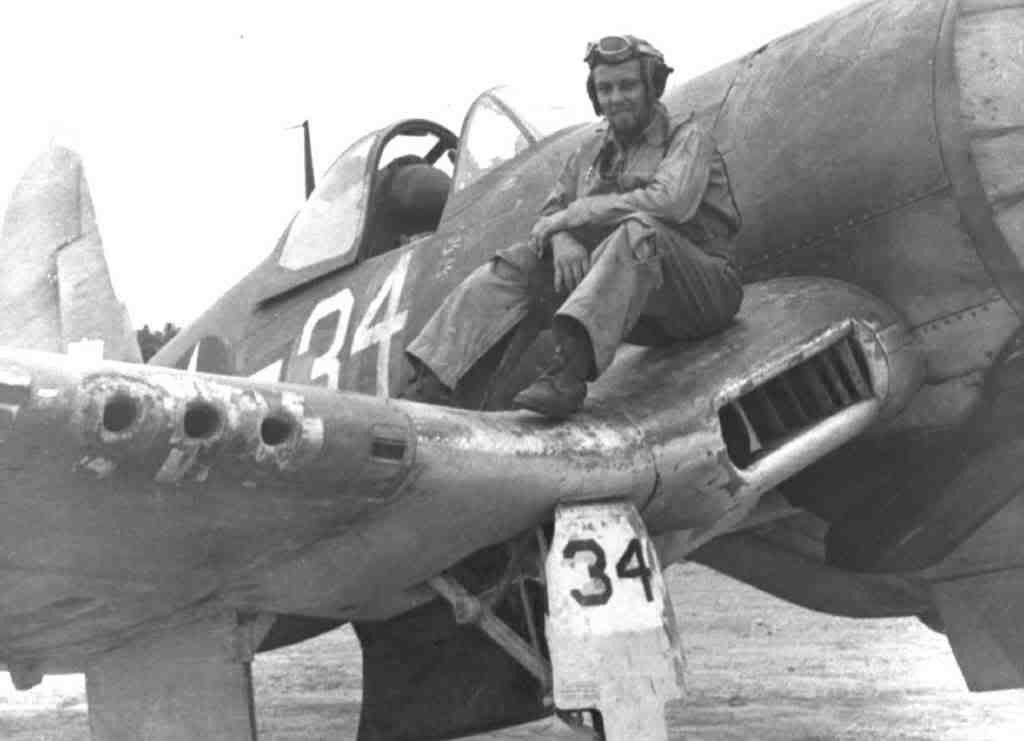
Production F4U-1s featured several major modifications compared with the XF4U-1. A change of armament to six wing-mounted .50 in (12.7 mm) M2 Browning machine guns (three in each outer wing panel) and their ammunition (400 rounds for the inner pair, 375 rounds for the outer) meant that the location of the wing fuel tanks had to be changed. In order to keep the fuel tank close to the center of gravity, the only available position was in the forward fuselage, ahead of the cockpit. Accordingly as a 237 gal (897 l) self-sealing fuel tank replaced the fuselage mounted armament, the cockpit had to be moved back by 32 in (810 mm) and the fuselage lengthened. In addition, 150 lb of armor plate was installed, along with a 1.5 in (38 mm) bullet-proof windscreen which was set internally, behind the curved Plexiglas windscreen. The canopy could be jettisoned in an emergency, and half-elliptical planform transparent panels, much like those of certain models of the Curtiss P-40, were inset into the sides of the fuselage's turtledeck structure behind the pilot's headrest, providing the pilot with a limited rear view over his shoulders. A rectangular Plexiglas panel was inset into the lower center section to allow the pilot to see directly beneath the aircraft and assist with deck landings. The engine used was the more powerful R-2800-8 (B series) Double Wasp which produced 2,000 hp (1,491 kW). On the wings the flaps were changed to a NACA slotted type and the ailerons were increased in span to increase the roll rate, with a consequent reduction in flap span. IFF transponder equipment was fitted in the rear fuselage. These changes increased the Corsair's weight by several hundred pounds.
F4U-1A
General characteristics
Crew: 1 pilot
Length: 33 ft 4 in (10.1 m)
Wingspan: 41 ft 0 in (12.5 m)
Height: 16 ft 1 in (4.90 m)
Wing area: 314 ft2 (29.17 m2)
Empty weight: 8,982 lb (4,073 kg)
Loaded weight: 11,432 lb (5,185 kg)
Powerplant: 1 × Pratt & Whitney R-2800-8 radial engine, 2,000 hp (1,491 kW)
Performance
Maximum speed: 417 mph (362 kn, 671 km/h)
Range: 1,015 mi (882 nmi (1,633 km))
Service ceiling: 36,900 ft (11,247 m)
Rate of climb: 2,890 ft/min (15.2 m/s)
Armament
Guns:
4 × 0.50 in (12.7 mm) AN/M2 Browning machine guns, 400 rounds per gun
2 × 0.50 in AN/M2 Browning machine guns, 375 rounds per gun
Rockets: 4 × 5 in (12.7 cm) High Velocity Aircraft Rockets and/or
Bombs: 2,000 pounds (910 kg)
F4U-4
AU-1 Corsair Standard Aircraft Characteristics
General characteristics
Crew: 1 pilot
Length: 33 ft 8 in (10.2 m)
Wingspan: 41 ft 0 in (12.5 m)
WS Folded: 17 ft 0.5 in (5.2 m)
Height: 14 ft 9 in (4.50 m)
Empty weight: 9,205 lb (4,174 kg)
Loaded weight: 12,405 lb (5,626 kg)
Powerplant: 1 × Pratt & Whitney R-2800-18W radial engine, 2,325 hp (1,710 kW)
Performance
Maximum speed: 453 mph (395 kn, 731 km/h)
Range: 897 mi (602 nmi (1,115 km))
Service ceiling: 41,500ft (12,649 m)
Rate of climb: 3,870ft/min (19.7 m/s)
Armament
Guns:
6 × 0.50 in (12.7 mm) AN/M2 Browning machine guns, 400 rounds per gun or
4 × 0.79 in (20 mm) M2 cannon
Rockets: 8 × 5 in (12.7 cm) high velocity aircraft rockets and/or
Bombs: 4,000 pounds (1,800 kg)
F-17 Jolly Rogers (1943-1959)
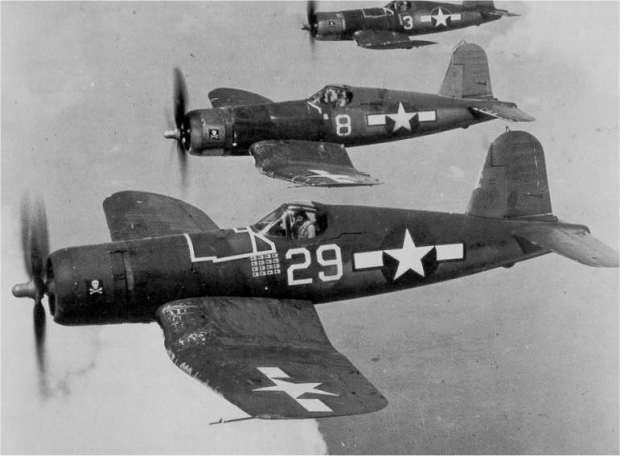
F4U-1As of VF-17.
The first incarnation of the Jolly Rogers was established on 1 January 1943 at NAS Norfolk, as VF-17. Initially based on the USS Bunker Hill (CV-17), the unit saw combat as a land-based squadron in the Solomon Islands in 1943-44, flying the F4U Corsair. The squadron was broken up in April 1944, but a new unit, with new personnel and aircraft, was formed with the same squadron designation. This new VF-17 served aboard the USS Hornet (CV-12), and flew the F6F Hellcat in the final drive across the Pacific in 1945.
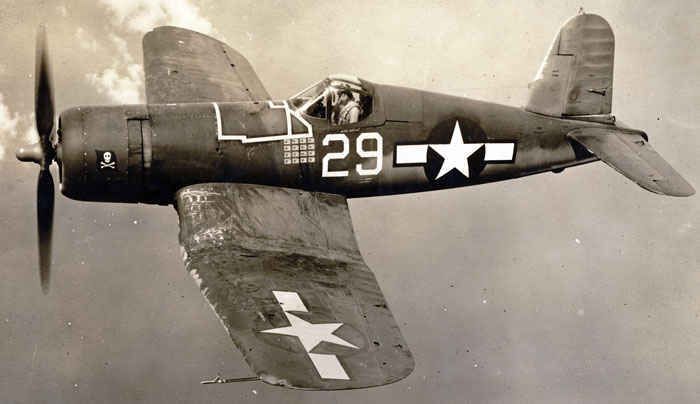
The iconic squadron insignia of VF-17, which had a stark white skull and crossbones emblazoned over a sinister black flag, was born from the desire of VF-17 squadron commander Lt. Cdr Tom Blackburn to have an insignia that had a piratical theme to it to match the F4U's designation which was "Corsair"
The first VF-17 had 11 aces and was credited with 152 victories; the second had 12 aces and 161 victories. Together VF-17 was the highest-scoring Navy squadron of World War II. In their five months of action in the Solomons, the Jolly Rogers shot down 8 Japanese planes for every Corsair lost. They flew 8,577 combat hours, destroyed 156 planes and 5 ships for a loss of 12 pilots. The squadron had 12 aces, more than any other naval unit. As the tide of the war in the Pacific turned, VF-17 was there.
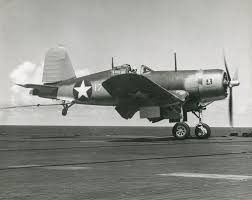
VF-17 was redesignated as VF-5B in 1946, and as VF-61 in 1948. It was disestablished on 15 April 1959.
(from Wiki and other sources)










 once that was done i found two pit of clear systrene and made sure they would fit then i drilled into them each and painted one "light bulb" orange and the other blue.