hi all, this post is very late ,i know

.
But i had a few problems witch has prevented me from getting in the man cave, so this may seem a bit hurried but it was a pleasure to finish it.
so to pick up were we left of , the seat was put together and then primed and then painted,
after drying the p e was sorted out ,this went on fine then gave it a wash,all pretty standard stuff really,have a look see.


then the seat was put in place , nice fit .


Yep pleased with that .
Ok there is one thing i have forgot all about is the history part of this project.
This is a well used old girl and has been around a while .
The MiG-21 jet fighter was a continuation of Soviet jet fighters, starting with the subsonic MiG-15 and MiG-17, and the supersonic MiG-19. A number of experimental Mach 2 Soviet designs were based on nose intakes with either swept-back wings, such as the Sukhoi Su-7, or tailed deltas, of which the MiG-21 would be the most successful.
Development of what would become the MiG-21 began in the early 1950s, when Mikoyan OKB finished a preliminary design study for a prototype designated Ye-1 in 1954. This project was very quickly reworked when it was determined that the planned engine was underpowered; the redesign led to the second prototype, the Ye-2. Both these and other early prototypes featured swept wings—the first prototype with delta wings as found on production variants was the Ye-4. The Ye-4 made its maiden flight on 16 June 1955 and made its first public appearance during the Soviet Aviation Day display at Moscow's Tushino airfield in July 1956.
In the West, due to the lack of available information, early details of the MiG-21 often were confused with those of similar Soviet fighters of the era. In one instance, Jane's All the World's Aircraft 1960–1961 listed the "Fishbed" as a Sukhoi design and used an illustration of the Su-9 'Fishpot'.
The MiG-21 has a delta wing. The sweep angle on the leading edge is 57° with a TsAGI S-12 airfoil. The angle of incidence is 0° while the dihedral angle is −2°. On the trailing edge there are ailerons with an area of 1.18 m², and flaps with an area of 1.87 m². In front of the ailerons there are small wing fences.
The fuselage is semi-monocoque with an elliptical profile and a maximum width of 1.24 m (4 ft 1 in). The air flow to the engine is regulated by an inlet cone in the air intake. On early model MiG-21s, the cone has three positions. For speeds up to Mach 1.5 the cone is fully retracted to the maximum aft position. For speeds between Mach 1.5 and Mach 1.9 the cone moves to the middle position. For speeds higher than Mach 1.9 the cone moves to the maximum forward position. On the later model MiG-21PF, the intake cone moves to a position based on the actual speed. The cone position for a given speed is calculated by the UVD-2M system using air pressures from in front and behind the compressor of the engine. On both sides of the nose there are gills to supply the engine with more air while on the ground and during takeoff. In the first variant of the MiG-21, the pitot tube is attached to the bottom of the nose. After the MiG-21P variant, this tube is attached to the top of the air intake.
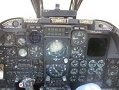
MiG-21F-13 cockpit at the Aviation Museum in Bucharest, Romania
The cabin is pressurized and air conditioned. On variants prior to the MiG-21PFM, the cabin canopy is hinged at the front. When ejecting, the SK-1 ejection seat connects with the canopy to make a capsule that encloses the pilot. The capsule protects the pilot from the high-speed airflow encountered during high-speed ejections. After ejection, the capsule opens to allow the pilot to parachute to the ground. However, ejecting at low altitudes can cause the canopy to take too long to separate, sometimes having resulted in the death of the pilot. Starting from the MiG-21PFM, the canopy is hinged on the right side of the cockpit.
MiG-21F-13 view from behind
On the under side of the aircraft there are three air brakes, two at the front and one at the back. The front air brakes have an area of 0.76 m², and a deflection angle of 35°. The back air brake has an area of 0.46 m² and a deflection angle of 40°. The back air brake is blocked if the airplane carries an external fuel tank. Behind the air brakes are the bays for the main landing gear. Also on the under side of the airplane, just behind the trailing edge of the wing are attachment points for two JATO rockets. The front section of the fuselage ends at former #28. The back section of the fuselage starts at former #28a and is removable for engine maintenance.
The empennage of the MiG-21 consists of a vertical stabilizer, a stabilator and a small fin on the bottom of the tail to improve yaw control. The vertical stabilizer has a sweep angle of 60° and an area of 5.32 m² (on earlier version 3.8 m²) and a rudder. The stabilator has a sweep angle of 57°, an area of 3.94 m² and a span of 2.6 m.
The MiG-21 uses a tricycle type undercarriage. On most variants the main landing gear uses tires that are 800 mm in diameter and 200 mm in width. Only the MiG-21F variants use tires with the size 660x200 mm. The wheels of the main landing gear retract into the fuselage after rotating 87° and the shock absorbers retract into the wing. The nose gear retracts forward into the fuselage under the radar.
Known MiG-21 aces[edit]
SolsticeMiGsmall (7633859414).jpg
Several pilots have attained ace status (five or more aerial victories/kills) while flying the MiG-21. Nguyễn Văn Cốc of the Vietnam People's Air Force (VPAF; also referred to as the NVAF), who scored nine kills in MiG-21s is regarded as the most successful.[89] Twelve other VPAF pilots were credited with five or more aerial victories while flying the MiG-21: Phạm Thanh Ngân,[1] Nguyễn Hồng Nhị and Mai Văn Cường (both eight kills); Đặng Ngọc Ngự[1] (seven kills), Vũ Ngọc Đỉnh,[1] Nguyễn Ngọc Độ,[1] Nguyễn Nhật Chiêu,[1] Lê Thanh Đạo,[1] Nguyễn Đăng Kỉnh,[1] Nguyễn Đức Soát,[1] and Nguyễn Tiến Sâm[1] (six kills each), and Nguyễn Văn Nghĩa[1] (five kills).
Additionally, three Syrian pilots are known to have attained ace status while flying the MiG-21. Syrian airmen: M. Mansour[90] recorded five solo kills (with one additional probable), B. Hamshu[90] scored five solo kills, and A. el-Gar[90] tallied four solo and one shared kill, all three during the 1973–1974 engagements against Israel.
Due to the incomplete nature of available records, there are several pilots who have un-confirmed aerial victories (probable kills), which when confirmed would award them "Ace" Status: S. A. Razak[91] of the Iraqi Air Force with four known kills scored during the Iran–Iraq War (until 1991; sometimes referred to as the Persian Gulf War), A. Wafai[92] of the Egyptian Air Force with four known kills against Israel.
For specific information on kills scored by and against MiG-21s sorted by country see the Mikoyan-Gurevich MiG-21
Right after doing the cockpit it was time to mask up and prime it, the weapons will be done as well but not on the plane .

the canopy was masked and the opening part was white glued in place for removal latter.


After the primer was dry i rubbed it down with some 2500 wet and dry to get here smoooooth.
then added the main under color .

moving on now to the upper part witch is mid stone semi gloss from guns.
i marked out the camo pattern with a pencil and spray the green on free hand with a point 2 needle in my air brush .

camo all done ready for the gloss coat and decals.

gloss coat done , ready for the decals.

decals done all except the real tiny ones and there all loads .

After this was dry , i did the weapons and all the small decals and under cart , i must admit i forgot to take photos of these ,running out of time .
so having said that if you would like to go over to the revel section you can see it in all its glory .
thanks for dropping bye




 ):
):