
Italeri Sukhoi SU-27d Sea Flanker 1:72 Scale Model #197
Payed $15.00 NZD
This is the Plane that I'm going to build in Paul's SU S>I>G Build, (out of the box) Have a look at the info off this plane its cool as, Cheers and enjoy "Glen"
The Sukhoi Su-27 (Russian: Сухой Су-27) (NATO reporting name: Flanker) is a twin-engine supermaneuverable fighter aircraft designed by Sukhoi. It was intended as a direct competitor for the large United States fourth-generation fighters such as the Grumman F-14 Tomcat and F-15 Eagle, with 3,530-kilometre (1,910 nmi) range, heavy aircraft ordnance, sophisticated avionics and high maneuverability. The Su-27 was designed for air superiority missions, and subsequent variants are able to perform almost all aerial warfare operations. It was designed with the Mikoyan MiG-29 as its complement (The role of the MiG-29 is tactical air superiority over the battlefield, engaging NATO fighters and strike aircraft).
The Su-27 entered service with the Soviet Air Forces in 1985. The primary role was long range air defence against American SAC B-1B and B-52G/H bombers, protecting the Soviet coast from aircraft carriers and flying long range fighter escort for Soviet heavy bombers such as the Tu-95 "Bear", Tu-22M "Backfire" and Tu-160 "Blackjack".
There are several related developments of the Su-27 design. The Su-30 is a two-seat, dual-role fighter for all-weather, air-to-air and air-to-surface deep interdiction missions. The Su-33 'Flanker-D' is a naval fleet defense interceptor for use on aircraft carriers. Further versions include the side-by-side two-seat Su-34 'Fullback' strike/fighter-bomber variant, and the Su-35 'Flanker-E' improved air superiority and multi-role fighter. The Shenyang J-11 is a Chinese licence-built version of the Su-27
The Sukhoi design, which was altered progressively to reflect Soviet awareness of the F-15's specifications, emerged as the T-10(Sukhoi's 10th design), which first flew on 20 May 1977. The aircraft had a large wing, clipped, with two separate podded engines and a twin tail. The ‘tunnel’ between the two engines, as on the F-14 Tomcat, acts both as an additional lifting surface and hides armament from radar.
The Su-27's basic design is aerodynamically similar to the MiG-29, but it is substantially larger. The swept wingblends into the fuselage at the leading edge extensions and is essentially a cropped delta (the delta wing with tips cropped for missile rails or ECM pods). The Su-27 is also an example of a tailed delta wing configuration, retaining conventional horizontal tailplanes, though it is not a true delta
Development of a version for the Soviet Navy called the Su-27K (Russian for "Korabyelny" - "Shipborne", NATO designation 'Flanker-D') commenced not long after the development of the main land based type. Some of the T10 demonstrators were modified to test features of navalized variants for carrier operations. These modified demonstrators led to specific prototypes for the Soviet Navy, designated "T10K" (Korabyelny). The T10Ks had canards, an arresting hook and carrier landing avionics as well as a retractable inflight re-fueling probe. They did not have the landing gear required for carrier landings or folding wings. The first T10K flew in August 1987 flown by the famous Soviet test pilot Viktor Pugachev (who first demonstrated the cobra manoeuvre using an Su-27 in 1989), performing test take-offs from a land-based ski-jump carrier deck on the Black Sea coast at Saky in the Ukrainian SSR. The aircraft was lost in an accident in 1988.
At the time the naval Flanker was being developed the Soviets were building their first generation of aircraft carriers and had no experience with steam catapults and did not want to delay the introduction of the carriers. Thus it was decided to use a take-off method that did not require catapults by building up full thrust against a blast deflector until the aircraft sheared restraints holding it down to the deck. The fighter would then accelerate up the deck onto a ski jump and become airborne.
The production Su-27K featured the required strengthened landing gear with a two-wheel nose gear assembly, folding stabilators and wings, outer ailerons that extended further with inner double slotted flaps and enlarged leading-edge slats for low-speed carrier approaches, modified LERX (Leading Edge Root eXtension) with canards, a modified ejection seat angle, upgraded FBW, upgraded hydraulics, an arresting hook and retractable in-flight refuelling probe with a pair of deployable floodlights in the nose to illuminate the tanker at night. The Su-27K began carrier trials in November 1989, again with Pugachev at the controls, on board the first Soviet aircraft carrier, called "Tbilisi" at the time and formal carrier operations commenced in September 1991.
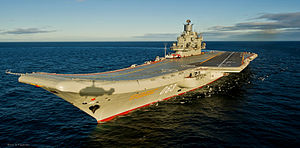
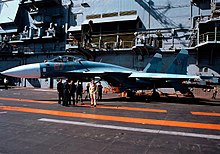
Su-27K (Su-33 / "Flanker-D"): Carrier-based single-seater with folding wings, high-lift devices, and arresting gear, built in small numbers. They followed the "T10K" prototypes and demonstrators
[youtube]8r3M9-3vcvQ[/youtube]
[youtube]ngOhVcxsDak[/youtube]

The Su-27 is armed with a single 30 mm Gryazev-Shipunov GSh-30-1 cannon in the starboard wingroot, and has up to 10 hardpoints for missiles and other weapons. Its standard missile armament for air-to-air combat is a mixture of R-73 (AA-11 Archer) and R-27 (AA-10 'Alamo') missiles, the latter including extended range and infrared homing models
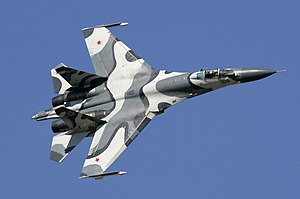
Su-27SKM at MAKS-2005 airshow
Role Air superiority fighter, Multirole fighter
National origin Soviet Union
Russia
Manufacturer Sukhoi
First flight 20 May 1977
Introduction 22 June 1985
Status In service
Primary users Russian Air Force
People's Liberation Army Air Force
Ukrainian Air Force
See operators for others
Produced 1982–present
Number built 809
Unit cost US$30 million
Variants Sukhoi Su-30
Sukhoi Su-33
Sukhoi Su-34
Sukhoi Su-35
Sukhoi Su-37
Shenyang J-11
Notable accidents:
From 9th September 1990 - 31st March 2013 there were about 12 reported accidents involving the SU-27. the worst being in 27th July 2002.
• 27 July 2002: A Ukrainian Su-27 crashed while performing an aerobatics presentation, killing 77 spectators. Both pilots ejected and suffered only minor injuries.[87]
Private ownership:
According to the U.S. FAA there are 2 privately owned Su-27s in the U.S.[77] Two Su-27s from the Ukrainian Air Force were demilitarised and sold to Pride Aircraft of Rockford, Illinois, USA. Pride Aircraft modified some of the aircraft to their own desires by remarking all cockpit controls in English and replacing much of the Russian avionics suite with Garmin, Bendix/King, and Collins avionics. The aircraft were both sold to private owners for approximately $5 million each.[78]
On 30 August 2010, the Financial Times claimed that a Western private training support company ECA Program placed a US$1.5 billion order with Belorussian state arms dealer BelTechExport for 15 unarmed Su-27s (with an option on 18 more) to organize a dissimilar air combat training school in the former NATO airbase in Keflavik, Iceland with deliveries due by the end of 2012.[79][80] A September 2010 media report by RIA Novosti questioned the existence of the agreement.[81] No further developments on such a plan have been reported by 2014, while a plan for upgrading and putting the retired Belorussian Air Force Su-27 fleet back to service was reported in February 2014
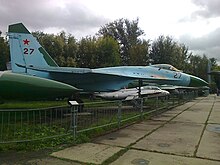
Aircraft on display
A Su-27, Red 27 is on display at the Central Armed Forces Museum in Moscow
General characteristics
• Crew: 1
• Length: 21.9 m (72 ft)
• Wingspan: 14.7 m (48 ft 3 in)
• Height: 5.92 m (19 ft 6 in)
• Wing area: 62 m2 (667 ft2)
• Empty weight: 16,380 kg (36,100 lb)
• Loaded weight: 23,430 kg. (51,650 lb.) with 56% internal fuel
• Max. takeoff weight: 30,450 kg (67,100 lb)
• Powerplant: 2 × Saturn/Lyulka AL-31F turbofans
• Dry thrust: 7,670 kgf (75.22 kN, 16,910 lbf) each
• Thrust with afterburner: 12,500 kgf (122.6 kN, 27,560 lbf) each
• Leading edge sweep: 42°
Fuel capacity: 9,400 kg (20,724 lb) internally[103]
Performance
• Maximum speed:
• At altitude: Mach 2.35 (2,500 km/h, 1,550 mph)
• At sea level: 1,400 km/h, 870 mph[102]
• Range: 3,530 km (2,193 mi, 1,906 nmi) at altitude; (1,340 km / 800 mi at sea level)
• Service ceiling: 19,000 m (62,523 ft)
• Rate of climb: 300 m/s[104] (59,000 ft/min)
• Wing loading: 377.9 kg/m2 (444.61 kg/m2 with full fuel) (77.3 lb/ft2 with 56% fuel)
• Thrust/weight: 1.07 with 56% internal fuel; 0.907 with full fuel
• Maximum g-load: +9 g
Armament
• 1 × 30 mm GSh-30-1 cannon with 150 rounds
• 4,430 kg (9,770 lb) on 10 external pylons[101][103]
Up to 6 × medium-range AA missiles R-27, 2 × short-range heat-seeking AA missiles R-73