

Well I've been thinking about doing a piece of Soviet armour and decided it was time to fish out the SU-76 kit from where it's been languishing under the bench for the last three years and show it some cement

First up some history on the type courtesy of our friends at Wikipedia:
The SU-76 (Samokhodnaya Ustanovka 76) was a Soviet self-propelled gun used during and after World War II. The SU-76 was based on a lengthened and widened version of the T-70 light tank chassis. Its simple construction made it the second most produced Soviet armoured vehicle of World War II, after the T-34 tank. Crews liked the vehicle for its simplicity, reliability, and ease of use. However, the steering was also sometimes regarded as difficult, leading crews to also refer to the vehicle as suka (Russian: сука; "bitch") or suchka (Russian: сучка; "little bitch"). It was also nicknamed Golozhopiy Ferdinand (Russian: Голожопый Фердинанд; "bare-arsed Ferdinand") due to its very light armor and somewhat similar silhouette, when compared to the Germans' heavy Ferdinand/Elefant casemate tank destroyer of some 65 tonnes in weight.

History
Design of the SU-76 began in November 1942, when the State Defence Committee ordered the construction of infantry support self-propelled guns armed with the ZiS-3 76.2 mm anti-tank gun and the M-30 122 mm howitzer. The T-70 chassis was chosen for mounting the ZiS-3 gun, and was lengthened, adding one road wheel per side, to facilitate better gun mounting. The vehicle was not completely enclosed by armour, the rear roof and upper rear side exposed.
The power-plant setup installed in the first mass-produced SU-76s was unreliable. Two GAZ-202 automobile engines were used mounted in "parallel", each engine driving one track. It was found to be difficult for the driver to control the two engines simultaneously, and strong vibration forces led to early failures of engines and transmission units. After 320 SU-76s had been made, mass production was halted in order to resolve the problems. Two chief designers at the GAZ plant, N. A. Astrov and A. A. Lipgart, changed the power-plant arrangement to that of the T-70 - the two engines were mounted in tandem on the right hand side of the vehicle. The armoured roof over the gun compartment was removed to improve access to and servicing of the weapon. This modified version, called the SU-76M, was placed in mass production in early 1943.

After production resumed, GAZ and two factories in Kirov and Mytishchi produced 13,932 SU-76Ms; over 9,000 of the vehicles were built solely by GAZ. Mass production of the SU-76M ceased in the second half of 1945. The SU-76 was the basis for the first Soviet tracked armoured anti-aircraft vehicle, the ZSU-37. Mass production of the ZSU-37 was continued after SU-76M production ceased. All SU-76Ms had been withdrawn from front-line service shortly after the war ended, although some were retained as training vehicles for T-34 crews as late as 1955.
Combat history
The SU-76M virtually replaced infantry tanks in the close support role. While its thin armour and open top made it vulnerable to antitank weapons, grenades, and small arms, its light weight and low ground pressure gave it good mobility. The SU-76M combined three main battlefield roles: light assault gun, mobile anti-tank weapon and mobile gun for indirect fire. As a light assault gun, the SU-76M was well-regarded by Soviet infantrymen (in contrast with their own crews). It had more powerful weapons than any previous light tank for close support and communication between infantry and the SU-76M crew was simple due to the open crew compartment. This was extremely useful in urban combat where good teamwork between infantry and AFVs was a key to success. Although the open compartment was highly vulnerable to small arms fire and hand grenades, it very often saved the crew's lives in the case of a hit by a Panzerfaust, whose concussion blast would mean death in an enclosed vehicle.

The SU-76M was effective against any medium or light German tank. It could also knock out the Panther tank with a flank shot, but the ZiS-3 gun was not effective against Tiger tanks. Soviet manuals for SU-76M crews usually instructed the gunner to aim for the tracks or gun barrels when facing Tigers. To improve the SU-76M's anti-armour capabilities, armour-piercing composite rigid (APCR) and hollow charge projectiles were introduced. This gave the SU-76M a better chance against heavily armoured German vehicles. A low profile, a low noise signature and good mobility were other advantages of the SU-76M. This was ideal for organizing ambushes and sudden flank or rear strikes in close combat, where the ZiS-3 gun was sufficient against most German armoured fighting vehicles.
The maximum elevation angle of the ZiS-3 was the highest of all Soviet self-propelled guns. The maximum indirect fire distance was nearly 17 km. SU-76Ms were sometimes used as light artillery vehicles (like the German Wespe) for bombardments and indirect fire support. However the power of the 76.2 mm shells was not sufficient in many cases.
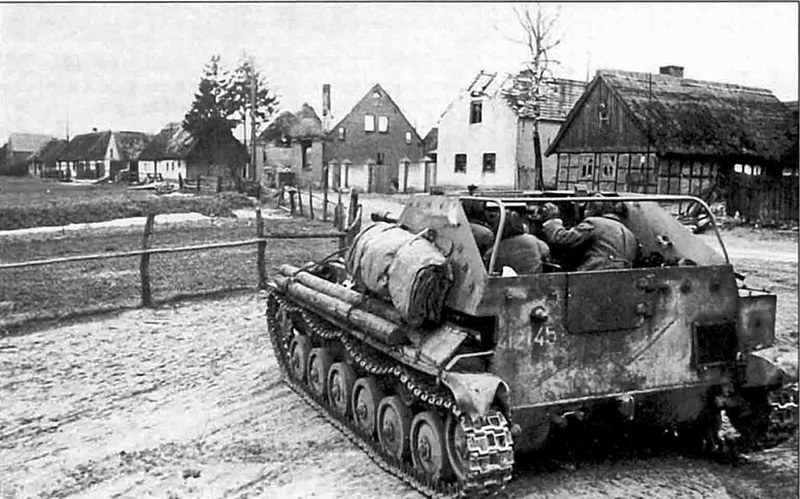
The SU-76M was the single Soviet vehicle able to operate in swamps with minimal support from engineers. During the Belarus liberation campaign in 1944 it was extremely useful for organizing surprise attacks through swamps; bypassing heavy German defences on firmer ground. Usually only lightly armed infantry could pass through large swampy areas. With SU-76M support, Soviet soldiers and engineers could effectively destroy enemy strongpoints and continue to advance.
The SU-76M had a large number of ammunition types. They included armour-piercing (usual, with ballistic nose and subcaliber hyper-velocity), hollow charge, high explosive, fragmentation, shrapnel and incendiary projectiles. This made the SU-76M an excellent multi-purpose light armoured fighting vehicle.
After World War II, the SU-76 was used by Communist forces in the Korean War. A small number of SU-76Ms were captured and used by South Korea after the landing at Incheon.









 ...
... 


 I would have said that most manufacturers give you a few spare links when they're individual like that, so maybe build slightly less than directly 50% of the total amount?




 (not
(not 




 Nicely done and looking the part now